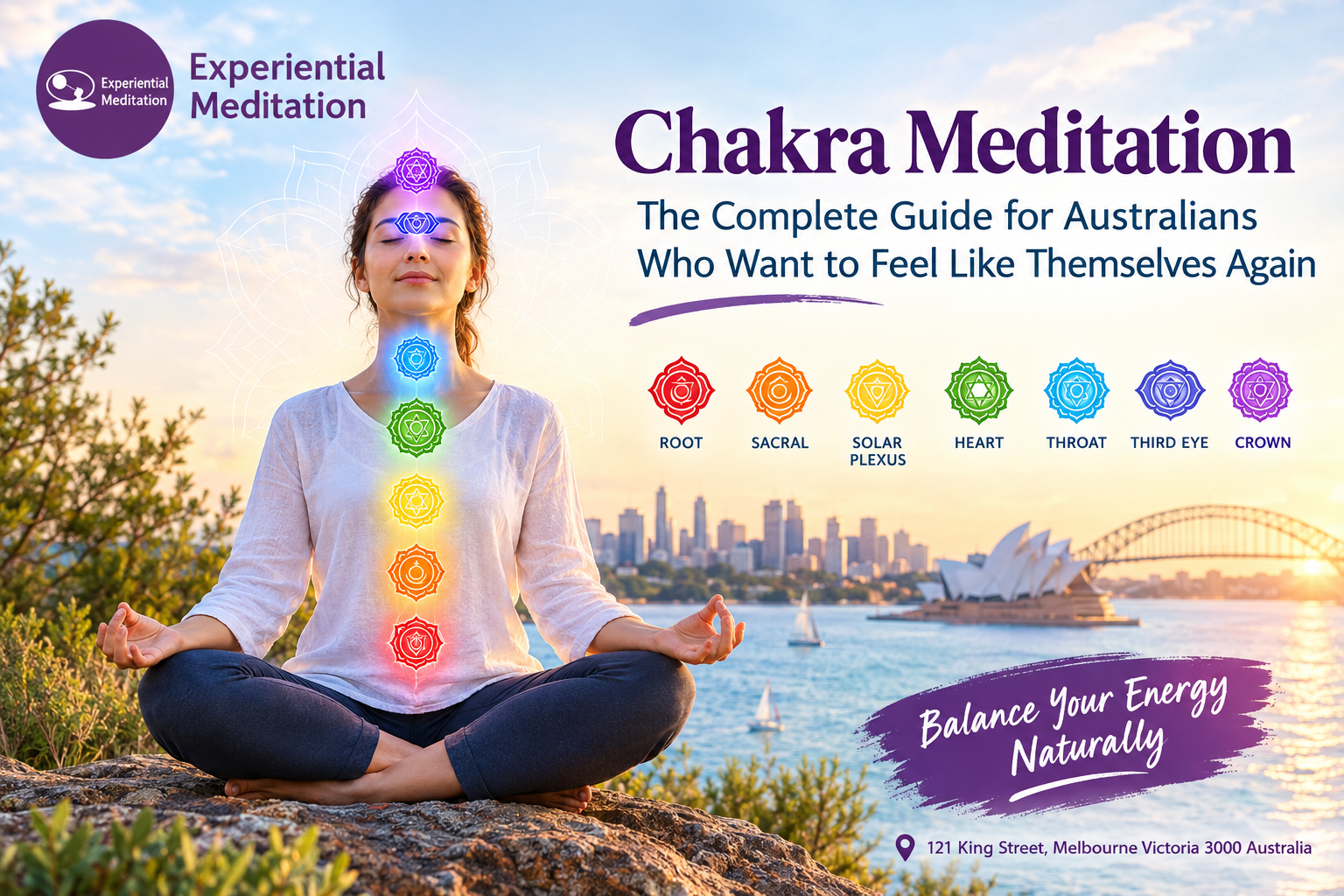
Chakra Meditation Guide Australia | Balance Your Energy Naturally
Chakra Meditation: The Complete Guide for Australians Who Want to Feel Like Themselves Again
There’s a particular kind of tired that coffee can’t fix. You’ve slept eight hours, ticked off your to-do list, maybe even squeezed in a walk along the beach — and you still feel like something’s off. Foggy. Flat. A bit disconnected from your own life.
If that sounds familiar, you’re not alone, and you’re definitely not broken. A lot of the people who come to us at Experiential Meditations describe exactly this feeling before they ever hear the word “chakra.” They’re not looking for a spiritual awakening. They just want to feel like themselves again.
That’s actually where chakra meditation shines. It’s not about crystals on your desk or incense burning in the background (though if that’s your thing, go for it). At its core, chakra meditation is a way of checking in with different parts of your body and mind, noticing where you’re holding tension, fear, or exhaustion, and gently working through it.
In this guide, we’re going to walk through what chakra meditation actually is, what the seven chakras represent in plain English, and — most importantly — how to start practising it yourself, even if you’ve got fifteen minutes and a lounge room floor.
What Is Chakra Meditation, Really?
The word “chakra” comes from Sanskrit and roughly translates to “wheel” or “disc.” In yogic and Ayurvedic traditions, chakras are described as spinning centres of energy that run along your spine, from the base all the way up to the crown of your head. There are seven main ones, each linked to different physical, emotional, and mental aspects of who you are.
Chakra meditation is the practice of focusing your attention on these energy centres, one at a time or as a whole system, to notice where things feel blocked, sluggish, or overactive. The idea is that when your chakras are balanced, energy flows through you freely. When one gets stuck — because of stress, old wounds, or just the daily grind of modern life — it can show up as anxiety, exhaustion, irritability, or even physical tension.
Now, you don’t need to buy into every metaphysical detail to get something out of this practice. Plenty of people who do chakra meditation aren’t necessarily “spiritual” in the traditional sense. They’ve simply found that spending focused time on different areas of the body and mind — using breath, visualisation, and intention — helps them feel calmer and more grounded. Think of it as a structured form of mindfulness with a body map attached.
The Seven Chakras, Explained Without the Jargon
Before you can meditate on your chakras, it helps to know what each one actually represents. Here’s a rundown, starting from the base of the spine and working upward.
1. Root Chakra (Muladhara)
Located at the base of your spine, the root chakra is all about safety, stability, and your basic sense of being okay in the world. When this one’s balanced, you feel grounded and secure. When it’s out of whack, you might notice anxiety about money, housing, or just a general sense of unease that’s hard to pin down.
2. Sacral Chakra (Svadhisthana)
Sitting just below your belly button, the sacral chakra governs creativity, pleasure, and emotional flow. A balanced sacral chakra means you can express yourself and enjoy life without guilt. When it’s blocked, you might feel emotionally numb or, on the flip side, overwhelmed by feelings you can’t quite process.
3. Solar Plexus Chakra (Manipura)
This one sits around your upper stomach, roughly where you’d feel “butterflies” before a big meeting. It’s connected to confidence, personal power, and self-esteem. People with a blocked solar plexus chakra often describe feeling powerless or overly self-critical.
4. Heart Chakra (Anahata)
Right in the centre of your chest, the heart chakra is about love, compassion, and connection — both to others and to yourself. When it’s open, relationships tend to feel easier and more genuine. When it’s blocked, you might notice walls going up, difficulty trusting people, or trouble with self-forgiveness.
5. Throat Chakra (Vishuddha)
Located at the throat, this chakra relates to communication and speaking your truth. A balanced throat chakra means you can say what you mean without over-explaining or shrinking yourself. A blocked one often shows up as a literal tightness in the throat, or a pattern of staying quiet when you really want to speak up.
6. Third Eye Chakra (Ajna)
Between your eyebrows, the third eye chakra is linked to intuition, clarity, and insight. When it’s balanced, decision-making feels easier and you trust your gut. When it’s out of balance, you might feel confused, indecisive, or stuck in overthinking loops.
7. Crown Chakra (Sahasrara)
At the very top of your head, the crown chakra represents your connection to something bigger than yourself — whatever that means to you personally. It’s tied to a sense of purpose and inner peace. A blocked crown chakra can leave you feeling disconnected, cynical, or like life lacks meaning.
You don’t need to memorise all of this before you start. Most people find that certain chakras “speak” to them more than others, based on what they’re currently going through.
Why Australians Are Turning to Chakra Meditation
We’ve noticed a real shift over the past few years. More people across Sydney, Melbourne, Brisbane, and regional towns are looking for ways to manage stress that don’t involve another app notification or another to-do list item. Life here moves fast — long commutes, a competitive job market, the constant pressure to be “on” — and traditional advice like “just relax more” doesn’t always cut it.
Chakra meditation appeals to a lot of people because it gives structure to something that can otherwise feel vague. Instead of just being told to “breathe and let go,” you’re given a specific area of focus, a body-based anchor, and a sense of progress as you work through each centre. It also tends to fit naturally alongside other wellness habits Aussies already love — yoga, ocean swims, bushwalking, or a quiet coffee before the day starts.
How to Practise Chakra Meditation: A Step-by-Step Approach
You don’t need a teacher, a studio, or fancy equipment to begin. Here’s a simple way to start, whether you’ve got five minutes or fifty.
Step 1: Find a Quiet Spot
This doesn’t need to be perfect. A corner of your bedroom, a spot in the backyard, or even your car during a lunch break can work. What matters is that you won’t be interrupted for the length of your session.
Step 2: Get Comfortable
Sit cross-legged on the floor, on a cushion, or in a chair with your feet flat on the ground. Some people prefer lying down, though this can make it easier to drift off, so sitting is usually better for staying present.
Step 3: Close Your Eyes and Breathe
Take a few slow, deep breaths. In through the nose, out through the mouth. Let your shoulders drop. This is your signal to your nervous system that it’s okay to slow down.
Step 4: Bring Your Attention to the Root Chakra
Picture the base of your spine. You can imagine a spinning wheel of red light there if visualisation helps, or simply place your attention on the physical sensation in that area. Ask yourself silently: do I feel safe and grounded right now? Sit with whatever comes up, without judging it.
Step 5: Move Upward Through Each Chakra
Slowly work your way up — sacral, solar plexus, heart, throat, third eye, crown — spending anywhere from thirty seconds to a few minutes on each one. Notice tension, warmth, tightness, or ease. You’re not trying to force anything to happen. You’re simply observing.
Step 6: Use Affirmations if They Help
Some people like pairing each chakra with a short phrase. For the root, something like “I am safe.” For the heart, “I am open to connection.” For the throat, “I speak my truth.” These aren’t magic words — they’re just a way to keep your mind anchored during the practice.
Step 7: Close With Gratitude
Once you’ve moved through all seven, take one more deep breath and gently open your eyes. Notice how your body feels compared to when you started. Even a small shift counts.
A full session might take fifteen to twenty minutes, but even a five-minute version focused on just one or two chakras — say, the ones you feel most drawn to on a given day — can make a genuine difference.
Common Mistakes Beginners Make
We see the same handful of hiccups come up again and again with people who are new to this practice.
Trying to feel something dramatic- Not every session will come with a big emotional release or a tingling sensation. Sometimes it’s subtle, and that’s completely normal.
Rushing through it- Chakra meditation isn’t a box-ticking exercise. Moving too quickly from one chakra to the next defeats the purpose of actually sitting with each one.
Overthinking the visuals- If you’re not a visual person, you don’t need to picture spinning wheels of coloured light in vivid detail. Focusing on the body sensation or the theme (safety, creativity, confidence, and so on) works just as well.
Expecting instant results- Like any form of meditation, chakra work tends to build over time. A single session might help you feel calmer for the afternoon; a regular practice tends to create more lasting shifts.
Techniques to Deepen Your Chakra Meditation Practice
Once you’ve got the basics down, there are a few ways to add depth to your sessions.
Colour visualisation — Each chakra is traditionally associated with a colour (red for root, orange for sacral, yellow for solar plexus, green for heart, blue for throat, indigo for third eye, violet or white for crown). Visualising these colours as you focus on each area can help hold your attention.
Sound and mantra — Chanting or silently repeating specific sounds (like “Lam” for the root or “Om” for the crown) is a traditional approach that some people find deeply calming. You don’t have to chant out loud if that feels awkward; even mouthing the sound or hearing it in your mind works.
Breathwork — Pairing each chakra with a slightly different breathing pattern, such as slower breaths for the lower chakras and lighter breaths for the upper ones, can help you feel the distinction between each energy centre more clearly.
Sound bowls or recordings — A lot of people in Australia have started using singing bowl recordings or chakra-tuned music in the background. It’s not essential, but it can help some people drop into the practice faster.
Yoga postures — Certain poses are traditionally linked to specific chakras. Grounding poses like mountain pose support the root chakra, while heart-opening poses like camel pose support the heart chakra. Pairing gentle movement with meditation can be a lovely combination, especially if sitting still for long periods feels uncomfortable.
Chakra Meditation for Anxiety and Stress
One of the most common reasons people search for chakra meditation is stress. It makes sense — when your nervous system is stuck in fight-or-flight mode, it can feel almost impossible to just “calm down” on command.
Chakra meditation offers a structured way in. Rather than trying to switch off anxious thoughts altogether (which rarely works), you’re giving your mind a specific job: focus here, notice this, breathe through that. This kind of directed attention can interrupt anxious spirals simply by giving your brain something else to do.
The root and solar plexus chakras tend to be particularly relevant here. Anxiety often shows up as a lack of safety (root) or a loss of personal power and control (solar plexus). Spending extra time on these two areas during a session can be especially grounding if you’re going through a stretch of high stress.
How Often Should You Practise?
There’s no single right answer, but a few sessions a week tends to be a sweet spot for most beginners. Some people build it into their morning routine, others prefer winding down with it in the evening. If you’re dealing with a particularly stressful period, even a short daily check-in — five minutes, one or two chakras — can help keep things from building up.
Consistency tends to matter more than duration. A short daily practice will usually get you further than one long session every few weeks.
Finding Support and Community in Australia
If you’d rather not go it alone, there are options. Yoga studios in most major Australian cities now offer chakra-focused classes, and wellness retreats — particularly along the east coast and in places like Byron Bay — often build entire weekends around chakra balancing work. Online communities and guided audio sessions are another accessible starting point if in-person classes aren’t practical for you right now.
Whatever path you choose, the most important step is simply beginning. You don’t need to get it “right.” You just need to sit down, breathe, and pay attention.
Frequently Asked Questions
Is chakra meditation backed by science?
Chakras themselves come from ancient yogic traditions rather than modern medicine, so there isn’t clinical evidence for chakras as physical structures. That said, the meditation and mindfulness components — focused breathing, body awareness, relaxation — are well supported by research on stress reduction.
Can beginners do chakra meditation without any experience?
Yes. There’s no prerequisite. Starting with just the root chakra for a few minutes a day is a perfectly good way to begin.
How long should a chakra meditation session last?
Anywhere from five to thirty minutes works. Shorter sessions focused on one or two chakras are a great starting point.
What if I don’t feel anything during meditation?
That’s completely normal, especially early on. The benefits often build gradually rather than showing up as an obvious sensation in each session.
Do I need to believe in energy or spirituality for this to work?
Not necessarily. Many people approach chakra meditation simply as a structured mindfulness tool and still find it helpful.
Which chakra should I start with?
The root chakra is a common starting point since it deals with basic safety and grounding, which tends to support the rest of the practice.
Can chakra meditation help with sleep?
Many people find that a short chakra practice before bed, particularly focused on the root and crown chakras, helps quiet a busy mind and ease into sleep.
Is it normal to feel emotional during a session?
Yes. Focusing on certain chakras, particularly the heart or throat, can sometimes bring up emotions you weren’t expecting. Let them pass through without forcing anything.
Do I need special equipment like crystals or bowls?
No. They can enhance the experience for some people, but a quiet space and your own breath are all you truly need.
How do I know if a chakra is blocked?
Common signs include persistent negative emotions tied to that chakra’s theme — for example, ongoing anxiety (root), creative block (sacral), or difficulty speaking up (throat). These aren’t diagnostic, just patterns worth paying attention to.
Final Thoughts
Chakra meditation isn’t about chasing some perfect, blissed-out state. It’s a practical way to slow down, check in with different parts of yourself, and notice what needs a little more attention. Whether you’re dealing with everyday stress, searching for a bit more clarity, or just curious about a new way to meditate, this practice offers a gentle, structured entry point.
Start small. Pick one chakra that feels relevant to what you’re going through right now, sit somewhere quiet, and give it five minutes. That’s really all it takes to begin.