Skip to content
logo logo
  • Home
  • Why Us
  • About Us
  • Instructions
  • Blog
  • Contact
  • Online Booking

Blog - Experiential Meditations

  • Home
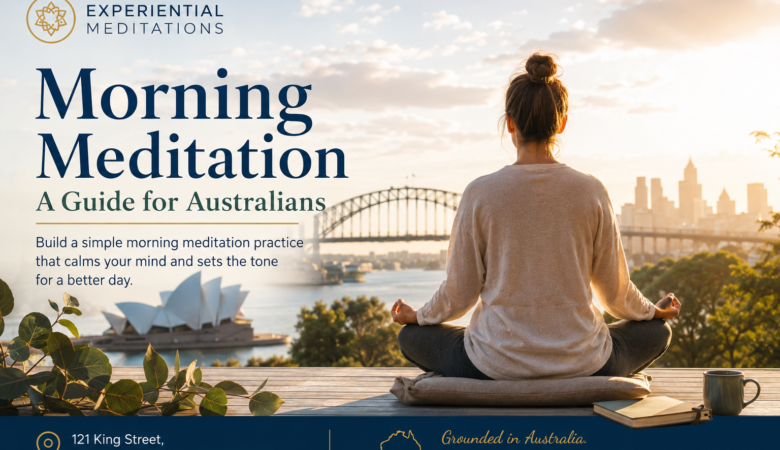
Morning Meditation: A Guide for Australians
By Experiential Meditations August 5, 2026August 7, 2026

Morning Meditation: A Guide for Australians​ There’s a particular kind of quiet that exists in the first twenty minutes after you wake up, before the phone gets checked, before the kettle goes on, before the day has had a chance to hand you its list of demands. Most of us waste that window. We reach for a screen and let someone else’s opinions, someone else’s crisis, someone else’s sale on protein powder set the tone for the next twelve hours. A morning meditation practice is really just a decision to take that window back. This isn’t about becoming a different person or sitting cross-legged on a mountain somewhere near Byron Bay chanting into the sunrise (although if that’s your thing, no judgement). It’s a lot more ordinary than that. It’s five to twenty minutes, a chair or a cushion, and a bit of patience while your mind does what minds do — which is wander off constantly and need to be brought back, over and over, like a puppy that hasn’t quite learned recall yet. If you’ve tried meditation apps before and given up after four days, or if you’ve always assumed meditation was for other people — calmer people, more disciplined people — this guide is for you. We’ll go through why mornings specifically matter, how to actually start (not the Instagram version, the real version), a handful of techniques worth trying, the mistakes almost everyone makes early on, and how morning meditation intersects with anxiety and stress specifically, since that’s usually the reason people show up looking for this in the first place. What Morning Meditation Actually Is (and Isn’t) Meditation has picked up a lot of baggage over the years. Depending on who you ask, it’s either a spiritual discipline thousands of years old, a productivity hack borrowed by tech executives, or a wellness trend attached to candles and essential oils. It can be any of those things, honestly, but at its core it’s much simpler: meditation is the practice of paying attention on purpose, without immediately reacting to whatever shows up. That’s it. That’s the whole thing. A morning meditation practice just applies that idea to the start of your day, before the noise builds up. You’re not trying to empty your mind — that’s a myth that stops more people from starting than almost anything else. Thoughts will show up. The trick isn’t to stop them; it’s to notice them without chasing them down a rabbit hole about that email you still haven’t sent. Some people picture meditation as sitting perfectly still with your eyes closed for an hour. In reality, a solid morning session might be: Five minutes of watching your breath while your coffee brews A ten-minute guided body scan before you get out of bed A short walk around the block where you’re deliberately not listening to a podcast All of these count. The form matters far less than the consistency. Why Mornings Specifically Work So Well You could technically meditate at any point in the day, and plenty of people do — a lunchtime reset, an evening wind-down before bed. But there’s a reason morning meditation gets talked about so much more than the alternatives, and it’s not just marketing. Your mind, in the first hour after waking, is in a slightly different state than it will be by 3pm. Cortisol naturally peaks not long after you wake — this is a normal, healthy process your body goes through every single day, sometimes called the cortisol awakening response. It’s part of what gets you moving. Meditating during or just after this window can help you meet that natural alertness with a bit more steadiness, rather than immediately spiking it further with a stressful scroll through emails or the news. There’s also the simple matter of decision fatigue. By evening, most of us have made hundreds of small choices, absorbed a dozen minor stresses, and have far less willpower left to sit quietly and do something that doesn’t feel urgent. Mornings, before the demands pile up, tend to be the point in the day when you have the most spare capacity — and the fewest excuses. And then there’s the tone-setting effect. How you spend the first twenty minutes after waking has a way of colouring the next few hours. Rush straight into checking your phone and your nervous system often stays in that reactive, slightly braced state for a while after. Sit quietly for ten minutes instead, and you’re far more likely to move through your morning at a pace you actually chose. How to Start a Morning Meditation Practice (Without Overcomplicating It) Most people who “fail” at meditation didn’t actually fail at meditation. They failed at an unrealistic version of it they built up in their head — twenty minutes a day, every day, forever, starting tomorrow. Here’s a version that’s far more likely to survive contact with real life. Start absurdly small. Two minutes. Not ten, not twenty — two. It sounds almost pointless, and that’s exactly why it works. A two-minute commitment is hard to talk yourself out of, and once you’re sitting there, you’ll often naturally stay longer anyway. The goal in the first fortnight isn’t depth, it’s simply showing up. Attach it to something you already do. Meditation habits that survive long-term are almost always anchored to an existing routine — right after you get out of bed, right after the kettle clicks off, right before you brush your teeth. Don’t try to build a brand-new slot in your morning from scratch; that’s asking your willpower to do more work than it needs to. Pick a spot and stick with it. It doesn’t need to be a dedicated meditation corner with a singing bowl and a plant (though there’s nothing wrong with that either). A specific chair, a specific side of the bed, a particular spot on the balcony. Your brain starts associating that physical location with the practice, which makes it easier to drop

Read More
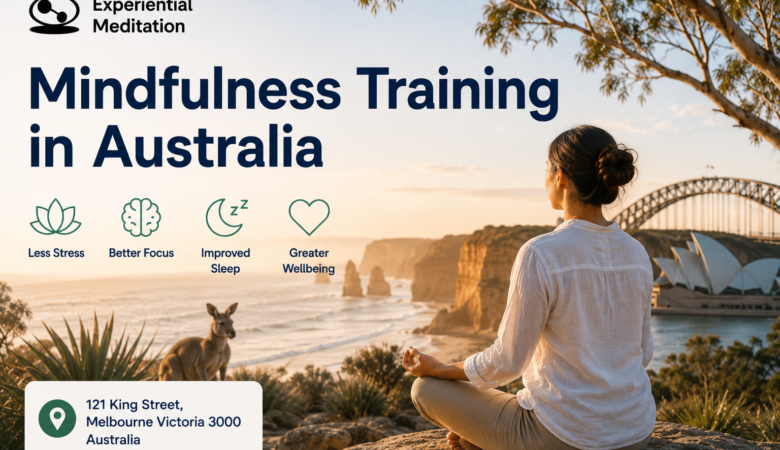
Mindfulness Training Australia: A Complete Guide
By Experiential Meditations August 1, 2026August 6, 2026

Mindfulness Training Australia: What It Actually Involves (And How to Start)​ If you’ve typed “mindfulness training” into Google, chances are you’re not looking for another listicle telling you to “just breathe.” You want to know what it actually is, whether it’s different from meditation, and how to find something legitimate — not a five-minute app notification pretending to be a life philosophy. Fair enough. Mindfulness training has become one of those phrases that gets stretched to mean almost anything, from a ten-minute guided audio to a full eight-week course run by a psychologist. In Australia, where workplace stress claims and anxiety-related GP visits have both climbed over the past few years, more people are searching for something structured rather than another app they’ll delete in a fortnight. This guide walks through what mindfulness training really involves, how it differs from casual meditation, the different formats available here in Australia, and — importantly — how to tell a proper program from a marketing exercise. What Is Mindfulness Training, Really? Mindfulness training is a structured way of learning to pay attention, on purpose, to what’s happening right now — your thoughts, your body, your surroundings — without immediately judging or reacting to it. That’s the textbook definition, and it’s accurate, but it doesn’t quite capture what the experience is like. In practice, mindfulness training usually means a guided program (anywhere from a single workshop to an eight-week course) that teaches specific techniques: breath awareness, body scans, mindful movement, and ways of noticing thought patterns without getting swept up in them. It’s less about achieving a blissed-out state and more about building a skill — the same way you’d train a muscle, except the muscle is your attention. The distinction matters because a lot of people arrive expecting meditation to switch off their thoughts entirely. It won’t. What mindfulness training actually does is change your relationship with those thoughts, so a stressful email doesn’t hijack your whole afternoon the way it used to. Mindfulness Training vs. “Just Meditating” This is probably the most common point of confusion, so it’s worth untangling. Meditation is the practice itself — sitting, breathing, focusing attention. Mindfulness training is the structured process of learning how to do that well, usually with a teacher who can correct your posture, answer questions, and help you understand why your mind keeps wandering off to your grocery list. Think of it like the difference between “going for a run” and “doing a running program.” You can absolutely go for a run without any instruction. But if you want to actually improve, avoid injury, and stick with it long-term, having someone guide the process makes a measurable difference. Mindfulness training does the same thing for meditation — it gives you a framework, feedback, and a community of people learning alongside you, rather than a solo Sunday-morning attempt that fizzles out by Wednesday. That’s also why people who’ve tried meditation apps on their own and given up often have better luck with a proper training program. The structure and accountability tend to be the missing piece, not the motivation. The Real Benefits — Beyond the Buzzwords It’s easy to be sceptical of mindfulness claims, especially with how commercialised the wellness industry has become. So let’s stick to what’s actually well-documented. Lower reactivity to stress. Mindfulness training doesn’t remove stressful situations from your life — your inbox will still fill up — but it changes how quickly your nervous system escalates in response. People who complete structured programs consistently report feeling less “hijacked” by minor frustrations. Better sleep onset. A racing mind at 11pm is one of the most common complaints we hear from people booking their first session. Mindfulness techniques, particularly body scans, are specifically useful here because they give your brain something concrete to focus on other than tomorrow’s to-do list. Improved focus and working memory. This one surprises people. Regular mindfulness practice has been linked to better sustained attention — useful whether you’re studying, in back-to-back meetings, or just trying to finish a book without checking your phone every four pages. Reduced rumination. Rather than replaying an awkward conversation for the fifth time, mindfulness training helps you notice the loop starting and step out of it earlier. None of this happens after one session. It’s closer to physiotherapy than a painkiller — the benefit builds with consistent practice, not a single dose. Types of Mindfulness Training Available in Australia Not every format suits every person, and this is where a lot of people give up too early — they try one style, decide “meditation isn’t for me,” and never realise there were three other formats that might have actually worked. In-Person Group Sessions These are the closest to a traditional class — a small group, a facilitator, and a set structure each week. The benefit is accountability and the shared energy of a room full of people also trying to sit still and stop checking their phones. Melbourne, Sydney, and Brisbane all have a growing number of studios offering these, often as six or eight-week courses. Online Mindfulness Workshops For people juggling shift work, parenting, or just living somewhere without a studio nearby, online workshops have become the more realistic option. A good one isn’t just a pre-recorded video — it should be live, interactive, and allow you to ask questions in real time. This format has grown significantly since 2020, and for regional Australians in particular, it’s often the only practical way to access proper instruction rather than driving an hour each way. One-on-One Coaching If you’ve got something specific going on — chronic anxiety, insomnia, burnout recovery — a one-on-one meditation coach can tailor the pace and technique to you directly, rather than a generic curriculum. It costs more, understandably, but it’s often the fastest route if group settings feel intimidating or if you’ve tried the generic approach before without much luck. Workplace Mindfulness Programs This is the format seeing the biggest growth right now, and for good reason.

Read More

Recent Posts

  • Morning Meditation: A Guide for Australians
  • Mindfulness Training Australia: A Complete Guide

Archives

  • August 2026

Categories

  • Meditation

About Us

At Experiential Meditation, we believe that true peace comes from the present moment. Our mission is to offer high-quality yoga and meditation sessions to individuals seeking mental clarity.

Quick Links

  • Home
  • About Us
  • Why us
  • Contact Us
  • Terms And Conditions
  • Side Effects

Contact Info

  • Info@experientialmeditations.com
  • help@experientialmeditations.com
  • 21 King Street Melbourne, 3000, Australia
Facebook-f Twitter Linkedin-in
Copyright © 2026 Experiential Meditations | Developed by Webvoom Pvt. Ltd.